
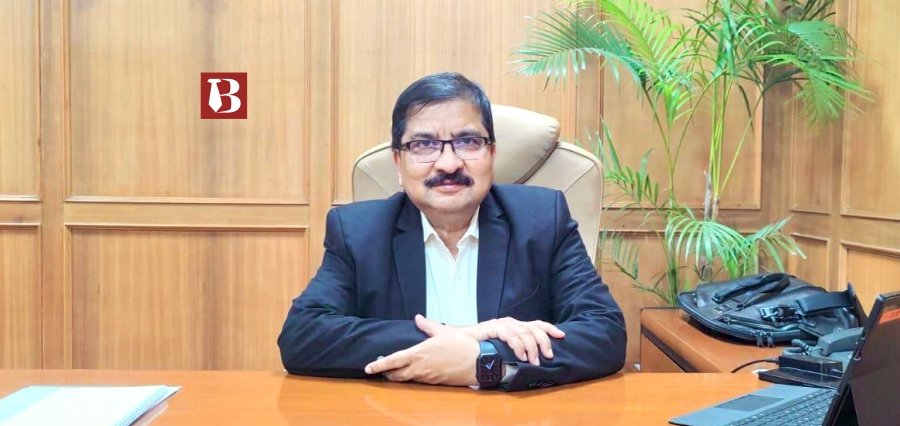
Sometimes the journeys undertaken by great leaders come not from the boardroom, but rather from the factory floor, where any form of inefficiency incurs costs, and decisions are made with quantifiable repercussions. The CEO of NAVTOM Consulting Private Limited, Asim Kumar Mukhopadhyay, boasts of a journey that spans more than four decades, thanks to this kind of approach. It could have been from his almost two-decade experience in India’s steel industry with the Steel Authority of India Limited or from his transformative leadership roles in companies such as Tata Motors.
As a result, he has been able to create his own perspective on how sustainable competitiveness cannot be established by optimizing any single function. The sustainable competitiveness is reached by ensuring that an organization integrates all its strategy with its implementation, its costs and value, its technology and people, and finally its sustainability and economics. Asim has grown as a person from being a performance manager to a performance anticipator and has redesigned.
Today, via NAVTOM Consulting, an entity that is built on the principles of “Navigating Tomorrow,” he takes his years of experience to help organizations transform and prepare for their future. The philosophy, which is based on Clarity Competes, is the result of many years of experience and a basic belief: that in constantly evolving markets and business models, clarity precedes competitiveness.
Explore Asim Kumar Mukhopadhyay’s journey and discover how clarity can become a catalyst for sustainable, future-ready leadership.
The Factory Floor as Classroom
Asim’s professional journey began in India’s steel industry, where he spent nearly two decades with the Steel Authority of India Limited. Steel, he explains, offers a blunt education in competitiveness. In a commodity business, a company cannot decide whether its product deserves a premium because costs have risen; the market shows little sympathy for inefficiency. “The furnace does not understand budgets. The customer does not reimburse inefficiency, and competitors certainly do not wait for an organization to catch up,” he says.
That environment cemented a belief that has stayed with him: cost is not merely a line item on a financial statement, but the result of thousands of decisions made across an organization, long before they appear as numbers. A rupee in a company’s accounts may have originated months earlier, in a design choice, a sourcing decision, or a logistics plan. he says.
That distinction later became central to his philosophy of cost leadership versus cost cutting. Cost-cutting asks a limited question: “Where can we spend less?” Cost leadership asks a far more ambitious question: “How can we fundamentally redesign the way we create value?” The difference might sound semantic, but in practice, it decides whether a company emerges from a cost transformation weaker or stronger.
From the Rear-View Mirror to the Windshield
Asim’s subsequent years at Tata Motors broadened that view considerably. Traditionally, the finance function existed to tell management what had already happened: revenue rose, margins declined, costs moved unfavorably, and working capital increased. The numbers were accurate, but they described yesterday. He grew drawn to a different question: can management systems tell leaders what will happen before it happens?
That shift, from reporting performance to influencing it, led him deeper into disciplines such as Activity-Based Costing, performance management, enterprise dashboards and Earned Value Management. The philosophy was simple: managers should not discover cost overruns only after a project has finished. Consider a large engineering project where half the planned budget has been spent.
Does that mean the project is halfway complete? Not necessarily, he points out; perhaps only a third of the actual work has been done. Traditional reporting would still show expenditure against budget, but Earned Value Management asks a harder question: “What value have we actually earned for the money and time consumed?” He believes that asking difficult questions early is what separates real performance management from simply reporting results.
Breaking the Invisible Wall
Over the years, Asim noticed another recurring pattern. Companies divide themselves into departments for administrative convenience, but customers never experience those departments individually. “The customer experiences the combined consequence of all of them,” he says. Yet organizations build invisible walls between functions: design optimizes for design, procurement for purchase price, manufacturing for efficiency, finance for budgets, and sales for volume. Each function can hit its own target while the organization, as a whole, still produces a suboptimal outcome.
This apparent contradiction became a defining theme in his thinking. Local optimization, he stresses, does not automatically translate into enterprise optimization. Sustainable competitiveness demands systems thinking, an ability to ask whether a decision in one part of an organization is quietly destroying value elsewhere. He believes that clarity makes that possible: once people understand the enterprise objective rather than merely their own departmental target, genuine collaboration replaces turf protection.
From Cost Leadership to Total Competitiveness
Over time, this thinking evolved beyond cost management altogether, because reducing cost alone cannot guarantee competitiveness. Asim offers a simple illustration: an organization could become extraordinarily efficient at manufacturing a product the market no longer wants, achieving cost excellence without competitiveness.
“The real question shifts from ‘How do we become lower cost?’ to ‘What makes customers choose us repeatedly and profitably?” Cost still matters, but so do quality, innovation, speed, customer experience, sustainability, resilience, and trust,” he says. He sees these as interconnected dimensions of what he calls Total Competitiveness, with leadership’s real task being to orchestrate them together.
The Electric Mobility Test
Nowhere was this system’s perspective tested more dramatically than in electric mobility. It is tempting to describe the shift from conventional to electric mobility as simply a change in propulsion technology, replacing an internal-combustion engine with an electric drivetrain. That description, he says, misses almost everything interesting about the transformation. Electric mobility changes the entire ecosystem: vehicles require batteries, batteries require charging, charging requires infrastructure, infrastructure requires reliable power, and operations require route and energy planning, all while the environmental benefit must coexist with economic viability.
In urban mass transportation, he notes, a vehicle cannot be considered separately from the service it delivers. A bus parked perfectly inside a depot creates little public value; its value emerges only when it reliably carries passengers, day after day. The experience reinforced an idea he had encountered repeatedly: business transformation succeeds when leaders stop looking at individual components and start seeing the ecosystem. Technology alone does not transform an organization; the business model must transform with it, and so must capabilities, processes and culture.
Sustainability Beyond Compliance
The same systems logic, Asim argues, applies to sustainability. For many organizations, ESG began as primarily a reporting or compliance responsibility, an interpretation he considers far too narrow. “Sustainability cannot remain a chapter in an annual report. It must enter the economics of business decisions,” he says.
Energy efficiency, material efficiency, and waste all affect cost; circularity affects resource security; carbon intensity increasingly affects market access; supply-chain resilience affects continuity; and governance affects trust and, ultimately, valuation. Companies that recognize this early can convert sustainability into a competitive advantage; those that treat it merely as compliance may discover that compliance was only the minimum entry requirement.
Lean. Green. Human.
This evolution finds expression in a future-readiness framework behind “Clarity Competes”: Lean, Green, and Human. Lean represents competitiveness, productivity, and the discipline to eliminate activities that consume resources without creating commensurate value. Green represents sustainability, not as philanthropy but as an integral dimension of strategy and value creation.
And Human recognizes something technology conversations occasionally forget that organizations do not transform, people do. Artificial intelligence may process information faster than humans, and analytics may reveal patterns invisible to managers, but leadership still requires judgment, empathy, courage, trust, and purpose. Future-ready organizations, in his view, cannot choose between technology and humanity; they must combine both.
The Leadership Lesson Hidden Inside Transformation
Four decades of experience have also reshaped Asim’s understanding of leadership. Early in a career, success can appear to depend on always having the right answer. Experience gradually teaches a different lesson. “Leadership is not always about having the answer. It is about enabling the organization to discover the answer,” he says. That requires listening, creating space for disagreement, and allowing people closest to a problem to help solve it.
Occasionally, it also requires leaders to challenge practices that have succeeded for decades. The most dangerous sentence inside a successful organization, he warns, is sometimes simply, “But this is how we have always done it.” Past success breeds confidence, and unchecked confidence turns into inertia. One of leadership’s greatest responsibilities, he believes, is recognizing when yesterday’s winning capabilities become tomorrow’s constraints, and finding the courage to disrupt success before competitors do it first.
Recognition, and a Different Measure of Success
Over his career, Asim has received significant professional recognition, including prestigious CFO honors from the Institute of Chartered Accountants of India and the Institute of Cost Accountants of India. Such recognition matters, but with time, his definition of achievement has evolved.
An award recognizes what a person has accomplished; a legacy, he says, reflects what continues after that person has left the room. Can an idea help another leader make a better decision? Can a management system keep creating value without depending on the person who built it? Can a young professional learn in five years what took an experienced leader twenty to discover?
These questions partly explain the emergence of “Clarity Competes,” a book less about prescribing management theory than translating decades of experience into ideas other leaders can apply. Its proposition is simple and demanding at once: organizations compete better when they become clearer about purpose, customers, value, cost, accountability, and the future they are preparing to enter.
NAVTOM: Navigating Tomorrow
After decades of transforming businesses from within large organizations, Asim eventually confronted his own transformation question: what next? Retirement could have marked the end of an executive career. Instead, it became the beginning of an entrepreneurial one. NAVTOM Consulting grew out of the idea of Navigating Tomorrow. Its purpose, he explains, is not simply to advise companies on what to do, but to partner with them through the entire journey from strategy to execution, from identifying opportunities to building the capabilities needed to capture them.
Strategic transformation, cost leadership, value enhancement, sustainable profitable growth, and future readiness may appear to be separate consulting propositions. In his philosophy, they belong to a single equation: an organization cannot remain profitable without staying competitive, cannot remain competitive without adapting, and cannot remain economically sustainable without also becoming environmentally and socially sustainable.
Advice to Tomorrow’s Leaders
What would four decades of experience suggest to the next generation of leaders? “Do not confuse position with leadership,” Asim says. A designation grants authority, but leadership earns followership. Second, “never outsource your learning,” he says, because expertise now has a short shelf life, and what worked yesterday may not suffice tomorrow.
Third, learn to connect the dots across disciplines, since tomorrow’s leader cannot think only like an engineer, an accountant or a marketer; problems rarely arrive with neat departmental labels. And fourth, protect integrity: reputation is built slowly and can vanish fast. Perhaps his most important advice, though, is simpler still: remain curious. “The moment a leader believes there is nothing left to learn is probably the moment decline has quietly begun,” he says.
Beyond Success, Towards Significance
The story of Asim is not simply a progression from steel to automobiles, finance to strategy, or conventional to electric mobility and corporate leadership to consulting. A quieter thread runs through it: the transition from success to significance. Success asks, “What have I achieved?” Significance asks, “What have I enabled others to achieve?” That is the journey NAVTOM now represents, and it is the legacy he hopes to build: organizations that grow stronger, leaders who become more capable, and management ideas that keep creating value long after the immediate assignment has ended.
Markets, technology, business models, competitors, and even the world’s definition of sustainability will keep evolving. Amid all this uncertainty, organizations will constantly face difficult choices, and those choices demand clarity. Because when everything around an organization is shifting, clarity is not merely an advantage. As Asim puts it, “Clarity competes.”