Shaping Future Workplaces
How companies acquire, develop, and manage talent has been transformed in every way. No longer are spreadsheets and paper files guiding the process of managing the workforce. In today’s world, digital HR transformation lies at the core of every modern talent management process, transforming the way HR organizations work, decide and create value for their business. Businesses that are embracing digital HR transformation are creating an agile, competent, and future-ready workforce. There is no room left for baby steps. Any forward-thinking company has to see its talent management process from a digital perspective or risk being permanently behind. The discussion around talent management is no longer process-driven. It is people-driven by technology.
From Administrative Function to Strategic Powerhouse
The role of HR department was once seen as a backstage department concerned primarily with payroll issues. This stereotype has been destroyed by the digital HR transformation. Using the technologies of intelligent systems, automation and analysis of big data in HR management has transformed people operations team into partners who contribute to bottom-line results.
The automation of the recruitment process and the use of digital tools for candidate selection and onboarding are some of the most evident examples of this trend. The process of hiring has become faster and more efficient due to these innovations, saving the time of the hiring managers searching through applications.
Data-Driven Decisions Replacing Gut Instinct
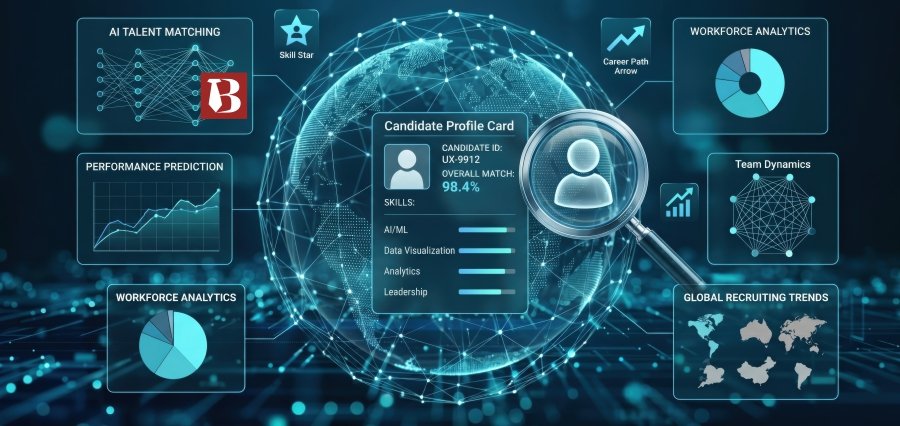
Among the greatest results of digital transformation of HR is the move towards evidence-based talent management. HR specialists receive access to comprehensive analytics related to all aspects, ranging from performance dynamics and skills shortages to engagement level and risk of staff turnover.
Thus, evidence-based decision making becomes possible in regard to the development of future organizational strategy. Instead of responding to the staff turnover, firms will be able to foresee signs of disengagement and act on them earlier. Succession planning, which was previously based mostly on subjective assessment, is now supported by objective performance metrics, competency mapping, and prediction models.
In consequence, the process of evaluating talent potential becomes more equitable and correct.
Personalizing the Employee Experience at Scale
Expectations from employees have changed. Contemporary employees expect customized learning paths, flexibility in learning options, and continuous feedback, not just an evaluation at the end of the year. With the advent of digital HR transformation, such levels of personalization can now be achieved, even for larger and dispersed teams.
Learning management systems are now able to customize content according to individual skills and career aspirations. Continuous feedback solutions help managers and their team members stay connected continuously, thus creating an environment of continuous development rather than periodic evaluations. Digital transformation helps achieve internal mentoring programs, internal mobility, and career pathing, thus allowing employees to see themselves having a bright future ahead in the organization.
When individuals feel appreciated, mentored, and challenged, they get more engaged. Increased engagement always means increased retention and productivity.
Breaking Down Silos with Integrated Technology
One of the lesser-known advantages of digital HR transformation is the integration of traditionally disjointed systems. Data from payroll, performance, learning, benefits, and recruitment were all in different silos, meaning it was hard to have an overview of everything.
Now, all these aspects can be integrated into a modern HR platform to provide for easy data flow throughout the entire journey of an employee. In the process of checking an employee’s performance, a manager will also see information about their training, pay, and engagement survey.
This not only leads to better decisions being made but also saves time on routine tasks. With approval requests, document management, and other duties automated by the software, HR specialists will have more time for actual work.
Building a Future-Ready Workforce
Most industries today require constant re-skilling and up-skilling of the organization’s workforce due to the speed of change. Digital HR transformation allows for just this kind of approach by detecting gaps, implementing relevant training and tracking progress in real time through analytics.
Today, this is no longer optional, but mandatory for any organization to thrive. The Boards and executives want HR to deliver measurable results that would have a direct effect on the ability of the workforce and thus performance of the organization.
Those organizations that will succeed in the coming years will be those who do not see digital HR transformation as a one-off project, but rather as a continuous process of building smart and human approaches to talent management.