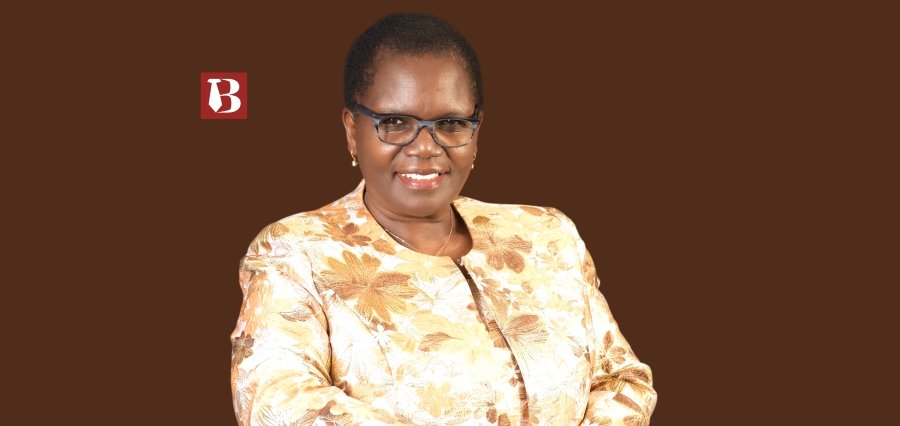
A career marked by resilience, fuelled by conviction, and driven by her dedication to educating girls and revolutionizing the systems, Hendrina Chalwe Doroba is an inspirational woman whose story cuts across continents.
There is a particular kind of clarity that arrives only through hardship, the moment when a child, standing at the edge of uncertainty, decides that what lies ahead will be better than what has come before. For Hendrina, that moment arrived not once, but twice, before she had even left secondary school. Together, those early experiences forged the architect of a career devoted entirely to one transformative truth: education, when given freely and without fear, changes everything. Currently, she is Division Manager-Education and Skills Development in the Africa Development Bank, making and marking a change.
Hendrina emphasises “Education is not merely a pathway to opportunity, it is a force powerful enough to transform a life.”
In today’s world, we have those who lead the way for now and those who do not mind taking on the task of rewriting the future. While the differences may not necessarily be evident by virtue of title or tenure, what will clearly distinguish these two types of leaders will be the decisions they make at the time of greatest personal cost and greatest uncertainty.
Her journey as a leader does not start in a conference room. In fact, her tale as a woman who has made many decisions that have led her down paths unknown began in a small village in Zambia. She has then built an impressive career full of consistency and morality.
It is not because of the collection of achievements that make this woman’s journey and her achievements significant. The constant theme in her journey has been her belief, one she held unwaveringly for decades in her career, that educating each girl rewrites a possible future. In a time when there is little focus or dedication, such leadership should be studied rather than merely acknowledged.
Born the seventh of eleven children in Zambia, she entered the world in a household where resources were scarce but hope, carefully tended by her parents, was not. When her parents separated, she moved briefly to her maternal grandparents’ village. It was there, in that vulnerable season, that her mother made a decision that would echo through the decades. Despite having very little, she fought to enrol her daughter in a weekly boarding school ten kilometres away. The fees eventually became unsustainable, but the lesson endured.
Her mother planted that conviction in her, and it has never left. Two years later, she went to live with her father, a head teacher at a remote primary school, who welcomed her and ensured her education continued.
In the stability he offered, she glimpsed what it meant when one adult chooses to stand firmly in a child’s corner. Both parents, in their own ways, had handed her the same inheritance: the belief that when even one child is given a chance, a different future becomes possible.
The Classroom That Changed Everything
Another formative rupture was in secondary school. A mathematics teacher repeatedly intimidated Hendrina, openly suggesting that, as a girl, she was incapable of excelling in the subject. It was a wound delivered in the very place where education was supposed to heal.
Rather than allowing rejection to define her, she turned it into motivation, working harder and studying beyond the prescribed syllabus to prove her capabilities. As her confidence in mathematics grew, she began helping classmates with the subject, discovering a passion for supporting others while deepening her own understanding. This transformative experience shaped her resilience, discipline, and leadership skills, eventually leading her to become Head Girl of Kalonga Secondary School and later train as a teacher of mathematics and geography. Looking back, she views that moment not as a setback, but as a turning point that fueled her determination and inspired her lifelong commitment to creating opportunities for others.
She resolved, with the quiet ferocity of someone who has been underestimated, that she would become exactly the kind of teacher and leader she had needed and never found: one who builds confidence instead of breaking it, who opens doors rather than closing them.
That resolution sent her into the teaching profession with a clear mandate. After graduating, she was first posted to a boys’ school, where the head teacher refused to accept her, citing her youth. She was then reposted to a girls’ boarding school in rural Zambia, and there she encountered a different but equally instructive obstacle: the girls themselves did not believe they could learn mathematics.
Many doubted that this young woman standing before them could be the one to change that. Hendrina persisted. With time, encouragement, and a refusal to accept the ceiling others had imposed, those same girls began to believe in themselves. Their academic performance improved dramatically, and many went on to occupy influential positions across Zambian society.
“That experience transformed me, it showed me that when girls are trusted, challenged, and supported, they do not merely pass examinations. They rise, lead, and reshape the world around them,” she reflects.
Widening the Lens: From Pedagogy to Policy
What followed was not a single career but a succession of deepening commitments, each one widening her view of how real change happens. As a classroom teacher, she saw firsthand how students learn and how a teacher’s belief shapes a student’s confidence, opportunities, and future possibilities. She then moved into in-service teacher training in mathematics pedagogy, where she came to understand that strengthening a system means first supporting the teachers within it, extending the quality of learning far beyond the students she could personally reach.
From there, she joined the development cooperation sector, supporting government decentralization efforts in education systems, before moving into civil society organizations where she built institutional capacity to influence education policy. Across these roles, she came to see how policy advocacy, partnerships, and government support had to move in concert to advance gender equality and strengthen education systems.
Her path eventually reached the continental level. At the Forum for African Women Educationalists (FAWE), she rose from programme officer to Executive Director- championing girls’ education across Africa and beyond. Under her stewardship, FAWE received the 2017 Al-Sumait Prize for the Development of Africa in the field of education, an honour that carried a one-million-dollar prize, a gold medal, and a shield, recognising the organisation’s exemplary leadership in promoting girls’ education across the continent.
“What began as one girl’s struggle to be seen and believed in has become a lifelong journey of empowering minds, transforming systems, and creating lasting impact,” she states
The Courage to Stand Firm
Hendrina’s ascent was not without its private battles. One of the most significant came during her pursuit of a scholarship to study in Australia. Being married then, she got initial support from her husband, but once she had won the scholarship, he tried to take away that chance from her.
However, she proved to be resilient enough to win this battle. Not only did she pursue the scholarship, but she was successful enough to complete her studies and emerge even more determined. It is true that this experience taught her how much extra effort a woman has to put in to achieve success, purely because of gender considerations, but she did not let that discourage her.
“Resilience is not only the ability to endure difficulty, it is the ability to remain rooted in purpose and to turn resistance into strength,” she says
Those experiences sharpened her empathy and deepened her commitment of creating a world in which girls and women are not held back by limiting beliefs, but are empowered to lead, excel, and transform society.
A Philosophy Built for Scale
Hendrina’s leadership philosophy has evolved alongside her understanding of power. While she once viewed power as authority concentrated among a select few with titles and resources, she now sees it as a responsibility to create opportunities, challenge outdated mindsets, strengthen systems, and enable others to thrive.
As Division Manager for Education and Skills Development at the African Development Bank, she believes that transformative leadership goes beyond inspiring individuals; it requires reshaping the policies, institutions, learning pathways, and social norms that influence access, representation, and success. For Hendrina, true leadership is about using influence with humility and purpose, shifting the focus from personal achievement to collective impact, and working to remove barriers so that future generations can pursue opportunities without facing the same obstacles she encountered.
Nowhere is this more evident than in how she approaches cross-cultural advocacy. When working in a community where early marriage was widely practised, she did not confront the culture directly. Instead, she shared the story of a girl from that same community who had left an early marriage, returned to school, completed her education, and become a role model. That story did what statistics and policy documents alone cannot: it allowed the community to see that supporting girls’ education was not a threat to cultural identity, but an investment in a richer future for everyone.
She applied the same principle in her engagement with governments on gender-responsive education policies. Rather than adopting a confrontational stance, she accompanied governments through dialogue, practical support, and evidence drawn from the lived experiences of girls, including those who had fallen pregnant and been excluded from school. The approach was deliberate: ground advocacy in real human stories, work alongside institutions rather than against them, and build a vision that people can embrace as their own.
“Leadership across cultures is not about imposing change; it is about building trust, finding common purpose, and shaping a vision that people can embrace as their own,” she explains
The Recognition That Matters Most
Ask Hendrina about the awards and public recognition she has received, and there have been many, she redirects the conversation with characteristic thoughtfulness. The recognition that carries the deepest personal meaning, she explains, is not the kind handed out at ceremonies. It is the quiet feedback she receives from the people she has mentored, supported, or encouraged along the way.
“The deepest recognition is not always what is formally awarded, but what is quietly reflected back through the lives that have been transformed,” she says. These are the moments that have sustained her through difficult seasons-the proof that her work extends far beyond the visible, into the private transformations of individuals who were enabled to see new possibilities for their futures.
The hardest professional decision she has faced reflects the same depth of character. When her team made a consequential mistake, despite the guidance she had provided, she chose to accept public responsibility for the failure. Guided by her core values of integrity, responsibility, and service, she understood that leadership is not only about taking credit when things go well. It is about standing firm, with honesty and humility, when they do not. She used the episode not as an occasion for blame, but as an opportunity to strengthen systems and deepen the team’s understanding of accountability.
Navigating Change Without Losing Ground
In a world changing at speeds that are too fast for most organisations to notice, Hendrina’s strategy of staying ahead involves two related approaches – one being a personal dedication to lifelong learning and the other being an organizational dedication to inclusive decision-making. She keeps herself open and receptive, always observing changes occurring outside the scope of her immediate field of activity, to be able to predict how these changes would impact those served by her organization.
As important as this is, she provides a conducive atmosphere for team members to come together, exchange views, introspect upon the organizational situation, and collectively figure out ways to stay relevant and responsive. For Hendrina, being open to learning and being an inclusive leader are not independent concepts. In fact, the two go hand in hand, giving her organisation the ability to be responsive and relevant to change without losing focus or purpose.
The Legacy She Is Building
In the future, it is quite evident that Hendrina knows very well what kind of legacy she wishes to leave behind. This legacy will be systemic in nature, whereby she will have contributed towards bringing changes in a global sense, whereby individuals can achieve their maximum potential and contribute to society in terms of their family, community, country, and the world at large through learning. It is this philosophy which believes that education and certain support systems help in realizing human potential on a global level.
However, it is also quite clear that she intends to focus on the human aspect of her legacy. She wishes to make efforts and focus on human beings by mentoring and supporting the emerging leaders of today, who were deprived of many such things when they themselves were starting in their professional lives. They should not go through the same struggles and hardships that she had gone through.
“True leadership also requires humility, the humility to know that no leader succeeds alone, and that the best results come when people are trusted and empowered to bring their gifts fully to the work,” she declares. This is the wisdom she now passes on: do not feel that you must have every answer to lead well. Be clear in purpose, grounded in values, and intentional about enabling others to grow, lead, and excel. Leadership, she insists, is not measured by how much one carries alone, but by how many others are strengthened and inspired to rise alongside you.
“The legacy worth leaving is more enabling systems and more prepared, courageous, and empowered leaders to carry the work forward, “she says
She has never been content with the view from where she stands. For as long as an ambitious woman made sure that her little girl attended a school located ten kilometres away from their home village, she continued to stretch herself into places where girls did not belong, into processes which had to be changed and into a tomorrow for which she worked tirelessly. A journey that started under conditions of struggle and hope has now been transformed by years of unwavering determination into achievements which transcend the boundaries of a classroom and a continent.
Her story is not simply the story of one woman’s achievement. It is, in fact, a testimony of what happens when education is approached as a truly revolutionary force and an educator makes up her mind to do nothing else but focus on it.